Featured Post

Doing Science activities with bare basics

This project, nicknamed SEE-SAW, is meant to provide opportunities for any student in any school to do science. Even for schools in the poor...

Friday, February 6, 2026

Do you want to measure the mass of the Earth, with a piece of string?!?!

 Have you wondered how we know the mass of the planet Earth? 

Try this activity, using a pendulum and a watch or timer to measure the period of the pendulum - the period is the time it take for one full swing of the pendulum - which can then be used to calculate the mass of the planet! It is possible to do the same thing on any other planet, or moon, or asteroid. This uses Newton's law of gravity, and the fact that the motion of a pendulum is dependent on how massive the planet is to do the calculation. 

The accepted mass is 6 x 10^24 kg, by the way!

Thursday, November 27, 2025

Some thoughts on: EELS as class pets, and how Quantum Mechanics changed my view of students (and humans generally)

 Go here to find deeper dives into EELS as class pets, where EELS stands for Everyday Essential Life Skills and a renaming and rebranding of SEL

Go here to find deeper dives into how Quantum Mechanics changed my view and mindset of who my students are (and humans generally), which I believe needs to happen with all educators across the country, regardless of grade levels taught. See my TED talk about some of this. 

Feel free to share on your social media platforms. Teachers, feel free to use any/all of this! 
#SEL #mindset #EduReforms #EducationMindset #education #teaching

Saturday, November 8, 2025

Consider doing UN SDG projects

 If you are looking for ideas for student projects, and having a wide variety of topics and options students can choose from, consider getting those ideas from the UN Sustainable Development Goals, or SDGs. In 2015, the UN published a list of 17 big issues and problems that affect every human being on the planet to some degree. Every country on earth signed on to commit to solving problems within these 17 goals, with a timetable of 2030. 

Students can choose from those 17 goals and try to think of local problems that fall within one or more of the goals, and then try to come up with their own solutions for the problem. Or a teacher can select one of the goals and have a class try to come up with a local problem and solution. These can be fun and rewarding, and unleash some creativity, research, and problem solving skills that may be able to actually help with a real-world problem, and in the process possibly help others who are affected by the problem. These types of projects often need science, math, and/or engineering to help generate solutions, so look for those aspects of problems you consider. If you have access to the Internet, perhaps consider using an AI such as ChatGPT to get ideas and develop them with an AI, which can be both helpful as well as provide some experience for students in the use of AI - a skill set that, whether we like it or not, today's students must have and be exposed to. 

Here is a spreadsheet of project ideas and topics my students have chosen over the last few years. We have had nearly 200 projects, by nearly 400 students, in nearly all 17 goal areas, from local to global scales. Many students have had their eyes opened by the range and scope of the problems that occur locally as well as in other parts of the US or world, that they never had thought about. Numerous students have gone to college and have looked for other ways to make a small difference by working on local issues...sometimes exposure to real problems, that affect real people, can change some students' lives to use those big, beautiful brains and hearts to do some good in the world at a really young age! 


Saturday, August 2, 2025

Two new animated resources for Teachers and Students

  I am breaking out two new animated resources that are most useful for elementary teachers. 

The first is a STEM story I wrote some years ago, but just had the text. It is entitled Little Sue and the Rock, and is a story for children in grades 1-3. The goal is to introduce to younger children the concept of atoms, and what atoms are made of. It goes through electrons, and a nucleus, and then that a nucleus is made of protons and neutrons. But then it introduces the fact that protons and neutrons are made of still smaller pieces called up and down quarks! Quarks are typically unknown even to high school science classes, and therefore high school students, which seems silly to me since I think it is fundamental we present the most basic ideas of what the world is made of in simple, and accurate, terms. By the way, it is fun to encourage and challenge students to write stories that try to explain a science or math topic! 


The second resource has to do with Social-Emotional Learning, or SEL. Most schools in the country have made it a goal, at some level, to bring in more SEL to deal with some of the issues we've been dealing with with children and teenagers since the Covid pandemic, specifically mental health issues. But SEL has become politicized and is under attack in many regions of the country, and has begun to be frowned upon by many educators. The trouble is, the skills described and contained in traditional CASEL SEL are actually essential life skills any parent would want their children to be strong in, in order to have a healthy and successful life! I am proposing and pushing for a re-branding of SEL to EELS - Everyday Essential Life Skills needed for successThis is a short booklet with animated pages that introduce and define what the EELS are, and I ask all who are parents to decide if the skills shown are part of "left wing indoctrination", or if they are skills you yourself use every day of your life, and are skills any parent would want their kids to know and be strong in. I have yet to find anyone who does not want kids to be strong in the listed skills! 

Monday, March 24, 2025

What does EducAid do? It changes lives through education

 Here is an EducAid video from 2016. It provides the mission and purpose of the organization in Sierra Leone. 


Saturday, January 11, 2025

STEM Education identified as the KEY to Africa's innovation & growth

 A UN report outlines how STEM education is necessary and the key to more innovation and growth in Africa. STEM is going to be the key to developing and implementing numerous issues around the world, identified through the UN Sustainable Development Goals (SDGs), and this is especially true in Africa, where, unfortunately, too many of the world's poorest nations are located. This report calls for African governments to invest more in STEM education. 

The purpose of the SEE SAW Project has been to provide ideas for active, hands-on lessons and labs for science and math classes in Sierra Leone, and anywhere else that can make use of them. The lessons assume there is little or no lab space, little or no science lab equipment and supplies, and even a lack of training to teach science and math this way by teachers. This is to help change how teachers teach science and math, and to encourage them to use their own creativity to develop their own labs and active lessons and even research programs, and begin to form a generation of innovators, scientists, and creators, who can help solve major problems in their regions! This is the hope and goal. 

Note that, as far as research projects for high school level students, this site has hundreds of ideas for real research that does not require professional laboratories or equipment. 

Wednesday, June 19, 2024

Search Engines you may not be aware of...there's more than just Google!

Here are some search engines you may not be aware of, most for STEM research:

 www.refseek.com - Academic Resource Search. More than a billion sources: encyclopedia, monographies, magazines.

www.worldcat.org - a search for the contents of 20 thousand worldwide libraries. Find out where lies the nearest rare book you need.

https://link.springer.com - access to more than 10 million scientific documents: books, articles, research protocols.

www.bioline.org.br is a library of scientific bioscience journals published in developing countries.

http://repec.org - volunteers from 102 countries have collected almost 4 million publications on economics and related science.

www.science.gov is an American state search engine on 2200+ scientific sites. More than 200 million articles are indexed.

www.base-search.net is one of the most powerful researches on academic studies texts. More than 100 million scientific documents, 70% of them are free

Don't forget if you do use Google, it is best to use Google Scholar for academic work: https://scholar.google.com/ 

Tuesday, October 24, 2023

Sound Activity - Rubber band instruments, figure out what sound is and some characteristics of producing sound

 One of our physics activities is the rubber band instrument. Check out the video for it. I was reminded of this one when my daughter, who is in college and preparing to become an elementary school teacher, was trying to find ways of doing sound experiments with first graders. 


Monday, July 24, 2023

SEL in Schools Series, for all educators and schools to use

  My students know I am really into the inclusion of helping humanity into our physics classes, and also promoting the skills we ALL need and use every day of our lives, Social-Emotional Learning skills (SEL). It is to the point where ETHS, and most districts around the country, are promoting and including SEL into their district plans and goals. This is good news for everyone, and now the challenge is to all learn what SEL is (and is NOT), why we need it for our students, evidence that it works (otherwise it would be a waste of time and resources), and finally how it can be embedded within content courses. 

If interested, I have created a SEL in Schools series of slide decks and accompanying videos, as well as hundreds of examples of lesson ideas in all subject areas/departments for middle schools and high schools, in order to train teachers and staff, as well as build up 'buy in' among teachers when they see how possible and valuable it is to include SEL in lessons on a fairly regular and consistent basis. 

Note that STEM courses are often viewed as the most challenging to include SEL within, so there's a video just on the use of SEL in STEM classes. 

If you happen to view it and find it useful, please share with other teachers, administrators, schools, etc. All of it is free, and with the slides you can make a copy and then use it or modify to your needs, as you please!

Sunday, February 26, 2023

For ALL of us to do- in general, it's OK to be nice to others!

 You can't be best friends with everyone, but you CAN: 

- notice everyone

- be friendly to everyone

- make room for everyone

- cheer for everyone

- listen to everyone

- have a smile for everyone

- say hello to everyone

- empathize with everyone

Oh, and you can be nice to yourself, too! 


Sunday, January 8, 2023

Doing science: 'Discovering' what the period of pendulums depends on

 This shows how students can go after determining what affects the period of a pendulum. 


Doing science: 'Discovering' Ohm's law

For schools that have electricity and equipment that can be used to set up simple circuits, this outlines an experiment where students can create an empirical formula for Ohm's law (and actually 'discover' Ohm's law). It shows how experimental science is done.  


Thoughts on Stopping the Science Brain Drain from Africa

 This is a relevant concern for many African nations. 


Sunday, July 17, 2022

TED Talk: New Mindset for how we think about students, inspired by Quantum science!

  I wanted to share my TED Talk, just out, about the Quantum Revolution in Education. In order to break educators everywhere from the traditional mindset that all students will more or less get the same experience and learning from any given lesson teachers provide, we need a more realistic mindset that drives home the fact students are unique, with their own emotional and intellectual states! 

They DO NOT get the same experience from any lesson we do! We must then ACT and INTERACT with students in different ways if we really mean what we say with "No Child Left Behind." 

This mindset is inspired by quantum mechanics, of all things, so check it out. 

Friday, June 24, 2022

If you have Internet: Use Netlogo to learn programming and do computational science

 Northwestern University researchers created a programming platform called Netlogo some years ago, and it's likely a million students, graduate students and even professors have used this to learn how to program, run its hundreds of prewritten simulations in just about every STEM field for assignments, or used it for actual, high-level research that is agent-based. 

If you have any Internet access, you can use any type of computer to access Netlogo. 

By agents, we mean individual objects or even organisms. Netlogo is designed to, as easily as can be done, develop programs and simulations where individual entities interact with each other by some set of rules or mathematical law. You can do orbits, for example, since this is just individual objects interacting through Newton's law of gravity. You can do growth of bacteria, since those are individual organisms that follow some statistical rule for reproduction. You can simulate forest fires since each tree is an individual organism (an agent), and the spread of fire follows a relatively simple rule (if a neighboring tree catches fire, those trees next to it will catch on fire). 

It is worthwhile to check this out. You can download it, or run it on the Web, so even ChromeBooks can use Netlogo. There is a library with hundreds of examples, and you are free to modify the code for any of them to learn the language and create your own versions of the original simulation! 

Tuesday, April 26, 2022

If Everyone saw this TED talk, there would be fewer deniers of climate change

 If you can watch this video and still deny something weird is not going on with our planet, then I will not be able to understand what other evidence is needed (unless one has other agendas they're after, and the evidence is inconvenient). A wonderful classic TED talk by James Balog, showing what is happening to the world's glaciers and ice sheets through time-lapse photography. Check it out. It is pretty convincing. Happy Earth Day, and let's never stop trying to make change for the health of our planet and future generations...


Sunday, April 17, 2022

Earth Day 2022 on April 22

 Earth Day is on Friday, April 22. Consider the U.N. SDGs again - are there little things you can do this week, and then perhaps every week, to help? Reducing time in the shower. Recycling. Turning lights and other electrical devices/appliances off. Composting food waste. Buying food you need, and reducing food waste and excess. Put some plants in the ground. Pick up litter in the neighborhood. Donate to and/or volunteer at a favorite organization doing good work. Post these types of actions on your social media platforms, encourage others to do the same (remember the multiplier effect on impact!). Be kind, compassionate and empathetic to others, while being grateful and respectful for what we have in our lives compared to most on the planet. 

Thanks for considering!! This is the only home we have, let's respect it and take care of it, always. 


Saturday, February 26, 2022

Elementary and Middle School Teachers may find SEE SAW Lessons useful

While this set of SEE SAW lessons developed to primarily help those schools overseas that do not have materials, supplies, equipment, or electricity and Internet access, teachers here in the United States and any other country or region may find them useful, as well, particularly elementary and middle schools that have limited supplies/equipment and/or time to do science. Unfortunately, some elementary schools only have an hour of science time every 1-2 weeks, as much more time is dedicated to reading and mathematics. Also, many elementary and middles schools have limited science budgets and access to materials and equipment. But in a STEM dominated world and economy, science education is obviously vital throughout a child's educational experience, including starting strong in elementary school

SEE SAW lessons are designed exactly for these situations! As always, feel free to use anything linked on this site. Use them as written, modify them for what best works for your classes, and even use them just to get ideas and see what's possible with nearly no equipment or resources and develop your own lab activities or demonstrations for the concepts and topics you study. 


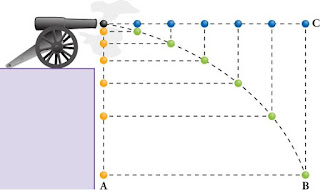
Physics Activity: Projectile Motion and predicting landing spots

 Lesson Plan for Projectile Motion and predicting where objects will land.                                                   Student lab sheet (includes how to find uncertainties in the predicted landing spot).

Projectile motion is studied in most physics classes, since projectiles are so common in our lives. The idea that the parabolic trajectory of a thrown or kicked ball is due to the combination of a horizontal motion of constant velocity with a vertical motion of constant acceleration (free fall) can be eye-opening for anyone who has wondered why things move along those curves in the first place! 

For those who want a more detailed explanation of the math behind projectile motion, check here. A second video looks at the change in trajectory when air friction is added

For those who have access to the Internet and want computer simulations, check this PhET simulation you can experiment with. 


Physics Activity - Modeling radioactive half-lives

 Lab sheet for students for Radioactive Half-lives (for introductory class)                                                     More advanced lab sheet for Radioactive Half-lives

Radioactivity is one of those words that largely scares people. It isn't always a bad thing, in fact our own bodies have radioactive materials in them! This term refers to the process of certain atomic nuclei spontaneously and randomly breaking down, where the parent nucleus decays/splits apart into other pieces. The 'stuff' that comes out of that decay process is radiation. Most radioactive processes result in one of three types of radiation being emitted from the material: alpha, beta, and gamma particles. 

Alpha particles consist of 2 protons and 2 neutrons (a helium nucleus). Beta particles/rays are electrons coming from the nucleus, as a result of a neutron decaying into a proton and electron (yes, neutrons are radioactive). Gamma rays are high-energy photons coming from the nucleus. 

One of the key properties of radioactive materials is their half-life. This is the time it takes an initial sample of a radioactive material to have half of that material decay. So if a half-life is 1 year, a 10 kilogram sample of the material will decay and about 5 kilograms will remain. In another year, only around 2.5 kilograms will remain. In another year, only around 1.25 kilograms will remain, and so on. Half lives can ranges from fractions of seconds to over a billion years! 

This lesson requires any large number of 2-sided items, such as coins or even a deck or two of playing cards. If you have certain candies available, such as M&Ms or Skittles, those can be used and students can eat them once done. Each time you have a cup-full of the items (it is ideal to have around 100 items for a small group of students to use as their 'radioactive sample'), that would represent one decay cycle over a half-life period. One side of the coins or candies represent an atom that decayed, and the other side means the atom is still 'alive.' Students count and keep the alive atoms, spill them again, and repeat until all atoms have decayed/died. Graphing the number of alive atoms to the spill number (i.e. how many half lives have gone by), students get the curve scientists use to determine how old certain fossils and other items are when they find them. It is an interesting procedure and method for doing this type of work!